Tokenisation news, 3 November 2026
This edition covers the launch of DTCC's tokenisation service with 20 firms, Uber's pilot buying and selling a tokenised Franklin Templeton money market fund with HSBC tokenised deposits, and Clearstream's authorisation as a Control Agent in Luxembourg.
Key takeaways
- DTC, part of the Depository Trust & Clearing Corporation (DTCC), launched the DTCC Tokenization Service on 28 October 2026, with 20 firms signed up, including J.P. Morgan, Citi and BNP Paribas.
- Uber used HSBC Tokenized Deposits to buy and sell shares in Franklin Templeton's tokenised money market funds on the Canton Network, selling part of its holding over a weekend.
- The CSSF authorised Clearstream to act as a Control Agent under Luxembourg's Blockchain Law IV, so managers can tokenise selected share classes of existing UCITS or AIF umbrellas.
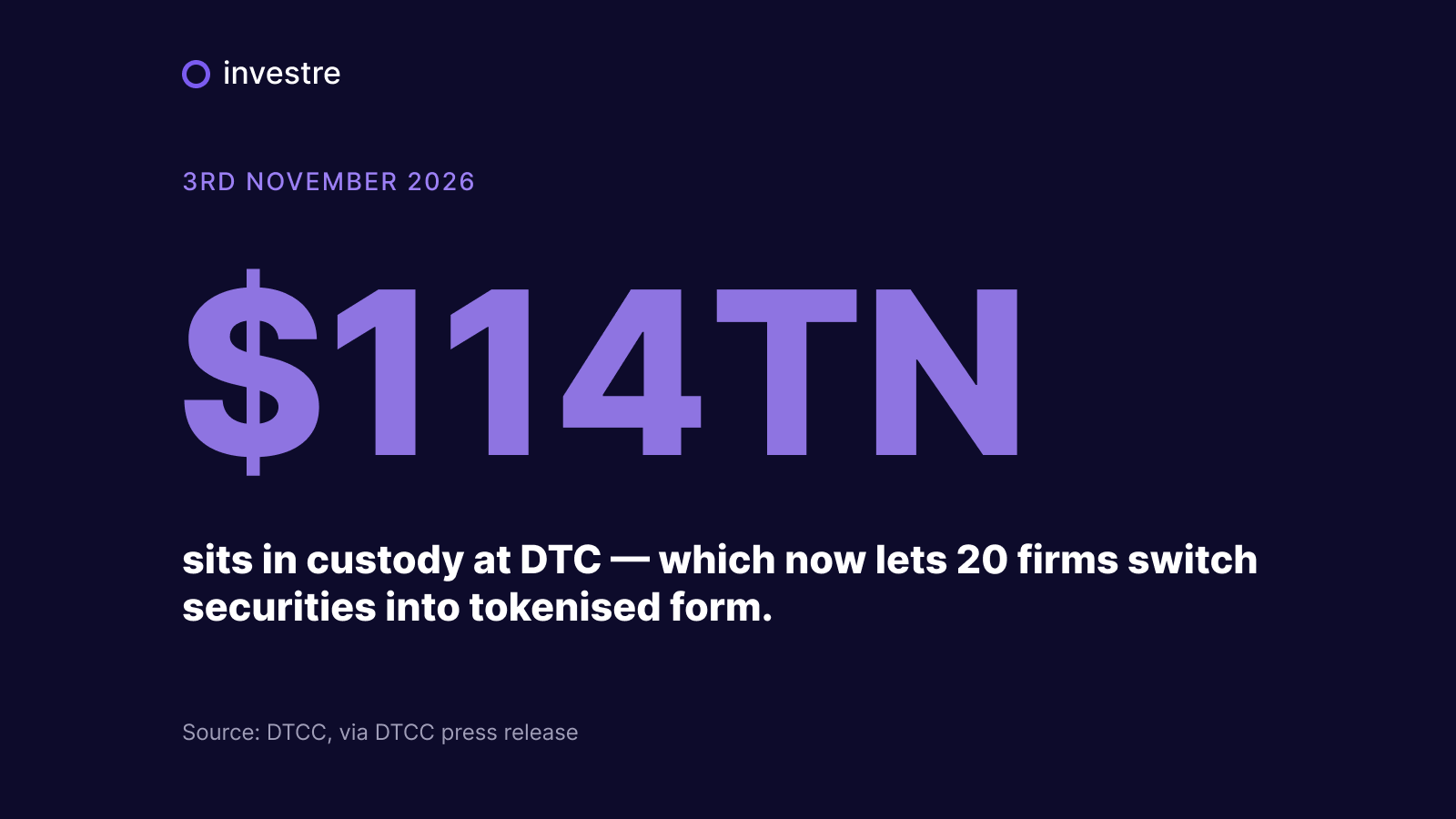
- More than 150 firms contributed to the DTCC Tokenization Service through DTC's industry working group, and DTC holds more than $114 trillion in assets in custody.
DTCC launches its tokenisation service with 20 firms, including J.P. Morgan, Citi and BNP Paribas
On 28 October 2026, DTC, the securities depository of the Depository Trust & Clearing Corporation (DTCC), launched the DTCC Tokenization Service. It lets eligible firms convert securities held at DTC between traditional and tokenised form and deliver them to digital wallets. According to DTCC, the tokens carry the same ownership rights, investor protections and economic entitlements as the underlying securities. Twenty DTC participants have signed agreements to use the service, including J.P. Morgan, Citi, BNP Paribas, State Street, Morgan Stanley and UBS. The service runs on the Canton Network and a private DTCC network, with more blockchains planned for 2027, and DTC holds more than $114 trillion in assets in custody.
The Investre take: With tokenised securities now in everyday use at the centre of US markets, European fund managers have a working model to learn from. Luxembourg already allows funds to issue shares directly on a ledger, so managers here can apply those lessons to their own share classes today.
Uber buys and sells a tokenised Franklin Templeton money market fund using HSBC deposits
Uber has completed a pilot, announced on 30 October 2026, in which it used HSBC Tokenized Deposits (bank deposits issued as digital tokens on a blockchain) to buy shares in Franklin Templeton's tokenised money market funds through the trading platform Tradeweb. The fund shares run on Franklin Templeton's Benji platform. The shares and the cash settled together, as delivery-versus-payment, on the Canton Network, a blockchain created by Digital Asset, with Fireblocks providing the wallet technology. Uber sold part of its holding over a weekend and kept earning yield until then. The aim was to keep corporate cash invested while still giving Uber access to it for payments outside banking hours.
The Investre take: To buy and sell tokenised funds on a blockchain, investors also need digital cash on that same blockchain, and money held at a regulated bank is the kind regulators trust most. The opportunity for Europe is to build a euro version at the same scale, so that tokenised European funds can trade in their own currency.
CSSF authorises Clearstream as a Control Agent for tokenised fund share classes
Luxembourg's financial regulator, the CSSF, has authorised Clearstream, Deutsche Börse Group's post-trade business, to act as a Control Agent under Luxembourg's Blockchain Law IV, Clearstream announced on 28 October 2026. A Control Agent acts for the fund issuer to oversee tokenised issuance. It keeps the central issuance account on a distributed ledger and reconciles the total issued against the positions investors hold. Asset managers will be able to tokenise selected share classes of existing UCITS or AIF umbrellas without launching a new fund, while their transfer agents, administrators, custodians and depositaries keep their core roles. The service still depends on the CSSF completing its regulatory processes.
The Investre take: A second Control Agent is good news for Luxembourg: it shows the country's framework is attracting major market infrastructure providers and gives fund managers more than one route to tokenisation. We see room for both models: adding a tokenised share class to an existing set-up, or issuing natively on a ledger from day one.
What this means for European fund managers
Luxembourg fund managers already have the legal basis to act on this. Luxembourg law allows a fund's share register to be kept directly on a distributed ledger, and managers can choose between two models: a digital transfer agent that keeps the register on-chain, or a Control Agent under the Blockchain IV Law that oversees tokenised issuance and reconciles issued shares against investor holdings. Investre is licensed for both, so managers can choose the model that fits their fund's set-up.
Further reading: Investre becomes the first Controlling Agent under Blockchain IV Law, or The Final Block podcast.
Authors