Tokenisation news, 27 October 2026
In the week to 27 October 2026, Hong Kong's Securities and Futures Commission approved round-the-clock trading of tokenised money market funds, J.P. Morgan brought its JPM Coin deposit token to the Ethereum blockchain, and Luxembourg's €1.7 billion blockchain-native government bond settled.
Key takeaways
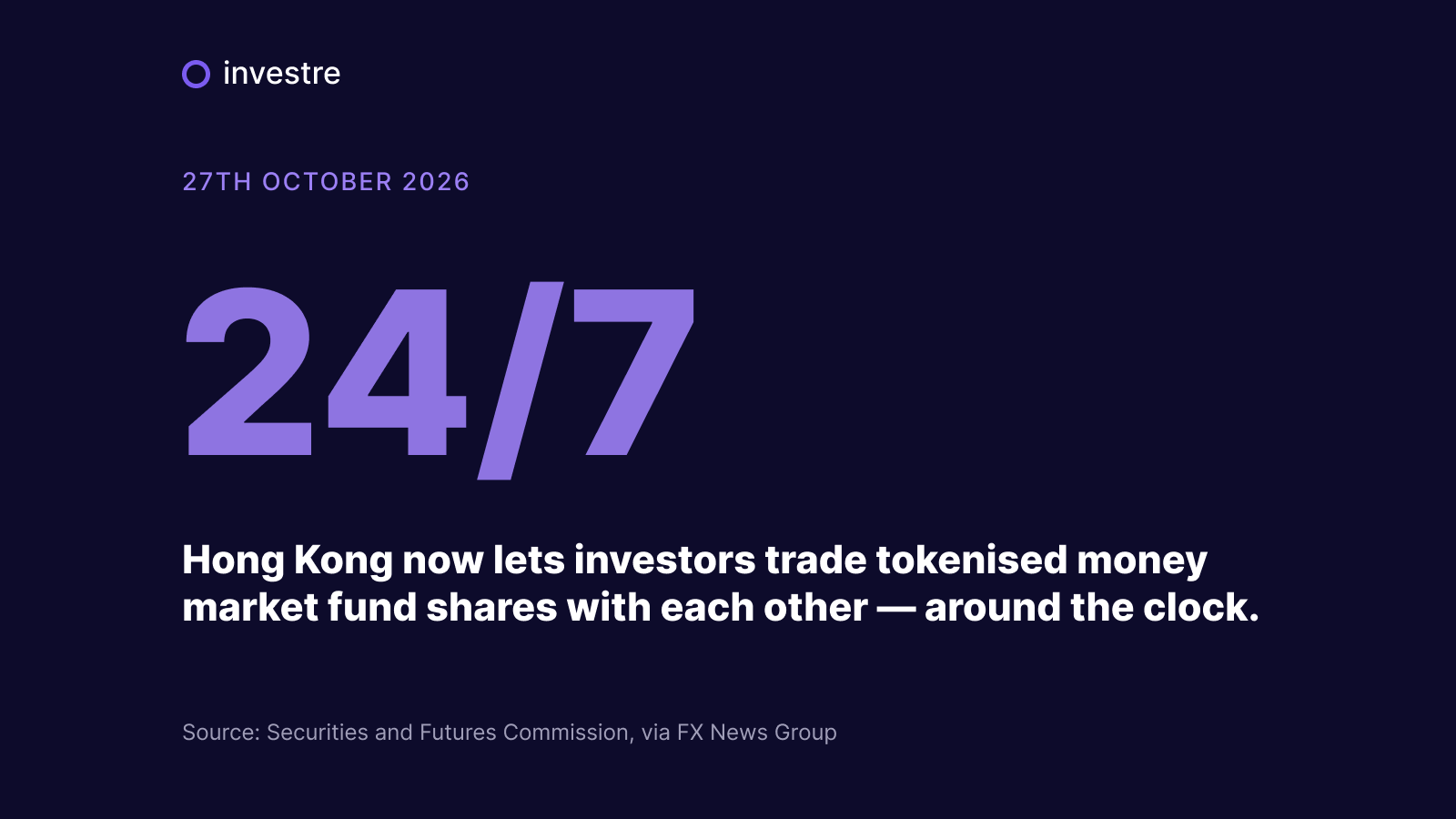
- On 26 October 2026, Hong Kong's Securities and Futures Commission (SFC) approved 24/7 trading between investors of two tokenised money market funds managed by ChinaAMC, one in Hong Kong dollars and one in US dollars, on licensed crypto trading platforms, which it describes as a world first.
- J.P. Morgan's blockchain unit Kinexys launched JPM Coin (JPMD), its US dollar deposit token, on Ethereum on 19 October 2026; it has been live on Base, a network built on Ethereum, since November 2025.
- Luxembourg's €1.7 billion, 10-year government bond issued natively on blockchain was placed on 14 October 2026 and settled on 21 October 2026 through LuxCSD, using Clearstream's D7 platform.
- Kinexys says it has processed more than $4 trillion in transactions across all its services since launch, averaging around $7 billion a day.
Hong Kong lets investors trade tokenised money market fund shares with each other around the clock
Hong Kong's Securities and Futures Commission has approved trading of tokenised public fund shares on licensed crypto trading platforms, which it describes as a world first. This means investors can buy and sell fund shares with one another, rather than only subscribing to and redeeming from the fund. The first two funds are the Hong Kong dollar and US dollar digital money market funds managed by ChinaAMC, both already authorised by the regulator, with trading running 24/7 from 26 October 2026. The approval follows a framework the commission introduced in April 2026 to pilot this kind of trading; it will start with money market funds and may widen the range of products later.
The Investre take: Once fund shares change hands between investors at any hour, the register has to keep pace in real time, and someone has to be legally accountable for it. Luxembourg already gives that job to the Controlling Agent; European managers should be asking whether their tokenised funds could support trading like this today.
J.P. Morgan makes its dollar deposit token available on the Ethereum blockchain
J.P. Morgan has made JPM Coin available on the Ethereum blockchain. JPM Coin is a deposit token: a digital version of US dollars held at the bank, which its institutional clients can send to one another directly on a blockchain. It first launched in November 2025 on Base, a network built on top of Ethereum. The bank says it lets clients hold and move dollars on a blockchain and manage their cash automatically, and that Kinexys, the J.P. Morgan unit behind it, has handled more than $4 trillion across all its services since it started, around $7 billion a day.
The Investre take: To buy and sell tokenised funds on a blockchain, investors also need digital cash on that same blockchain, and money held at a regulated bank is the kind regulators trust most. The opportunity for Europe is to build a euro version at the same scale, so that tokenised European funds can trade in their own currency.
Luxembourg's €1.7 billion blockchain government bond has now settled
Luxembourg's first government bond issued directly on a blockchain has now settled. The €1.7 billion, 10-year bond was fully bought by investors on 14 October 2026 and settled on 21 October 2026 through Luxembourg's central securities depository (LuxCSD), using a blockchain platform run by Clearstream. Investors can hold it through the systems they already use, including Clearstream and Euroclear Bank, and it is listed on the Luxembourg Stock Exchange. Banks can also pledge it as security when they borrow from the euro area's central banks.
The Investre take: A government bond that lives on a blockchain, yet works with Europe's existing systems and is accepted by central banks, answers the biggest doubt about blockchain issuance: that it doesn't fit into today's markets. Fund managers can no longer say tokenised products are cut off from the systems their investors already use.
What this means for European fund managers
Luxembourg fund managers already have the legal basis to act on this. Under the Blockchain IV Law, an authorised Controlling Agent can maintain a fund's share register directly on a distributed ledger, without the need for a transfer agent or central securities depository. Investre was the first firm authorised to take on this role.
Further reading: Investre becomes the first Controlling Agent under Blockchain IV Law, or The Final Block podcast.
Authors