Tokenisation news, 24 November 2026
In the week to 24 November 2026, the European Central Bank invited groups of financial firms to test tokenised deposits and securities, IOSCO reported that tokenised assets had more than doubled to $37 billion, and HSBC opened a tokenised money market fund to Hong Kong savers from HK$100.
Key takeaways
- On 20 November 2026, the European Central Bank invited groups of financial firms to test tokenised deposits and securities, including money market funds, under its Appia programme; applications for the first round close on 11 December 2026.
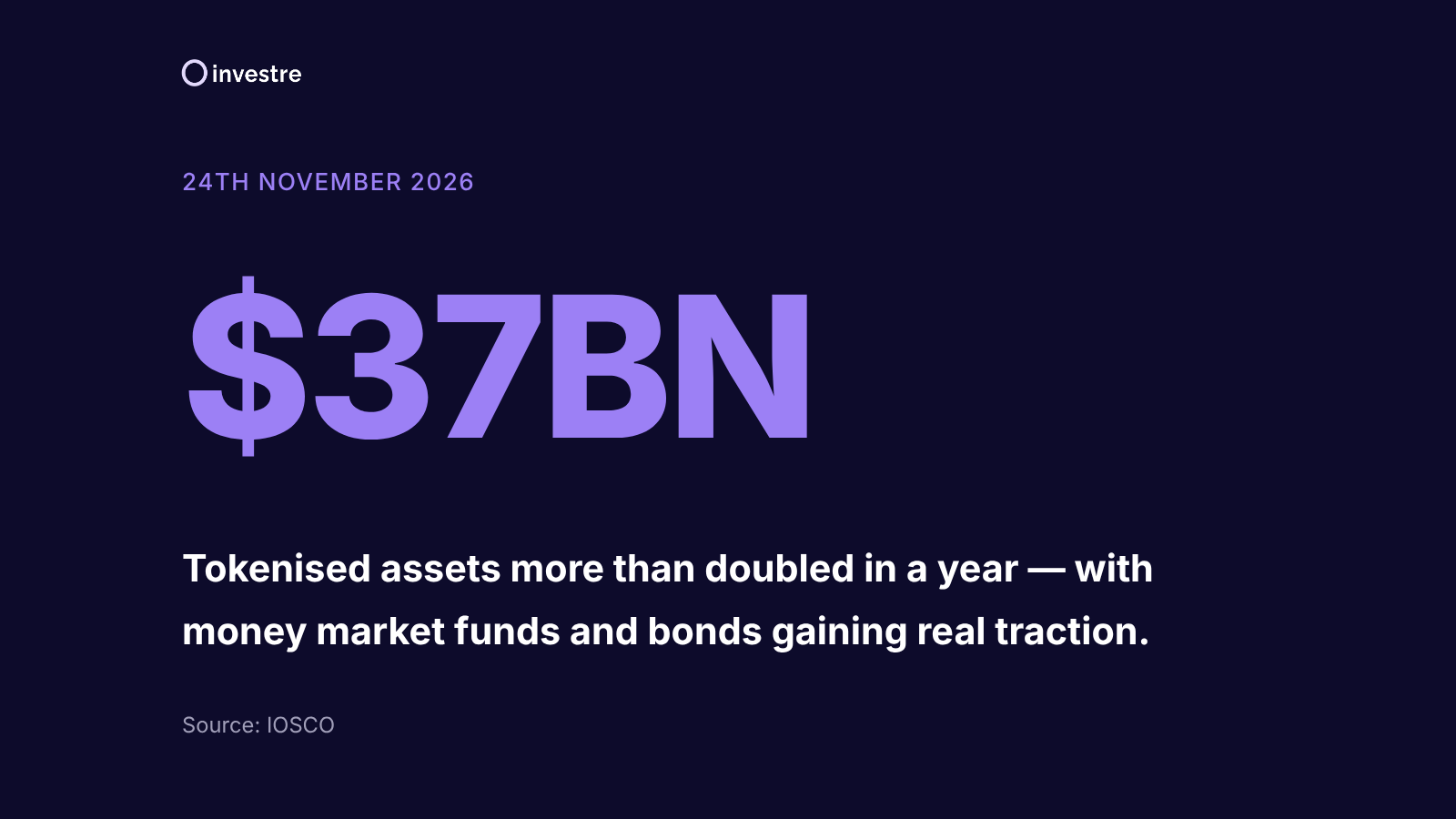
- IOSCO's 2026 report on tokenisation, published on 18 November 2026, found that tokenised real-world assets grew from about $16 billion in July 2025 to $37 billion at the end of June 2026.
- HSBC now lets Hong Kong customers buy a tokenised money market fund from HK$100 through its mobile app, paying with RedCoin, the bank's Hong Kong dollar stablecoin.
- Money market funds feature in all three: named in the ECB's tests, cited by IOSCO as gaining real traction, and offered by HSBC to retail savers.
ECB asks groups of financial firms to test tokenised deposits and securities by 11 December
The European Central Bank is inviting groups of financial firms to test how tokenised bank deposits and securities, including money market funds, could work across Europe under Appia, its programme to build a single market for tokenised assets. Each group needs at least five independent members from at least two euro-area countries, mostly regulated financial firms. Applications for the first round close on 11 December 2026, and the results will shape an Appia blueprint due by 2028.
The Investre take: The ECB is asking the industry to help design how tokenised funds and the cash behind them will move across the euro area. Fund managers, administrators and depositaries know that process best, and 11 December is the deadline to have a say.
IOSCO counts $37 billion in tokenised assets, more than double a year earlier, with funds gaining the most traction
IOSCO, the international body that brings together the world's securities regulators, published its 2026 report on tokenisation on 18 November 2026, finding that tokenised real-world assets grew from about $16 billion in July 2025 to $37 billion at the end of June 2026. Bond products and money market funds are where tokenisation has gained real commercial use, and several countries reported growing interest in tokenised fund units. The report still describes the market as transitional and fragmented, and warns that tokenised shares raise questions about how they are classified and marketed, especially across borders. "Investors must understand the rights and risks attached to what they hold," said IOSCO Board Chair Jean-Paul Servais.
The Investre take: When the world's securities regulators point to money market and bond funds as the place where tokenisation is working, the fund industry is no longer watching from the sidelines. Their warning on stock tokens points the same way: investors need to know exactly what they own, and that starts with a clear legal record of ownership.
HSBC lets Hong Kong savers buy a tokenised money market fund from HK$100 using its own stablecoin
HSBC is letting customers in Hong Kong buy into a tokenised money market fund through its mobile app from HK$100 (about US$13), paying with RedCoin, the bank's own stablecoin, a digital token backed by Hong Kong dollars. The fund's tokens sit on the public Ethereum blockchain, but the official register of unitholders is kept off-chain and final settlement takes place outside the blockchain. The fund invests mainly in short-term Hong Kong dollar deposits and money market instruments, has estimated ongoing charges of 0.38%, and for now units can only be bought from and sold back to the fund, not traded between investors.
The Investre take: HSBC has put the token on a public blockchain but kept the official register off it, a reminder of how much tokenisation still relies on the record-keeping behind it. In Luxembourg the register itself can live on-chain, kept by either a digital transfer agent or a Controlling Agent, so the token and the legal record are one and the same.
What this means for European fund managers
Luxembourg fund managers already have the legal basis to act on this. Under Luxembourg's Blockchain Laws, a fund's share register can be kept directly on a distributed ledger, either by a digital transfer agent or by an authorised Controlling Agent under the Blockchain IV Law, depending on how the fund is set up. Investre is licensed for both models and was the first firm authorised as a Controlling Agent.
Further reading: Investre becomes the first Controlling Agent under Blockchain IV Law, or The Final Block podcast.
Authors