Tokenisation news, 20 October 2026
In the week to 20 October 2026, Federated Hermes partnered with Prometheum to sell tokenised funds through US brokerage accounts, start-up Fission raised $10 million to buy tokenised fund shares from investors who want to exit early, and nine US-listed companies blocked tokenised trading of their stock on the OKX–ICE venue.
Key takeaways
- Federated Hermes, with $911.6 billion under management as of 30 June 2026, announced on 13 October 2026 that it will issue tokenised funds with Prometheum, with the first product expected in Q1 2027.
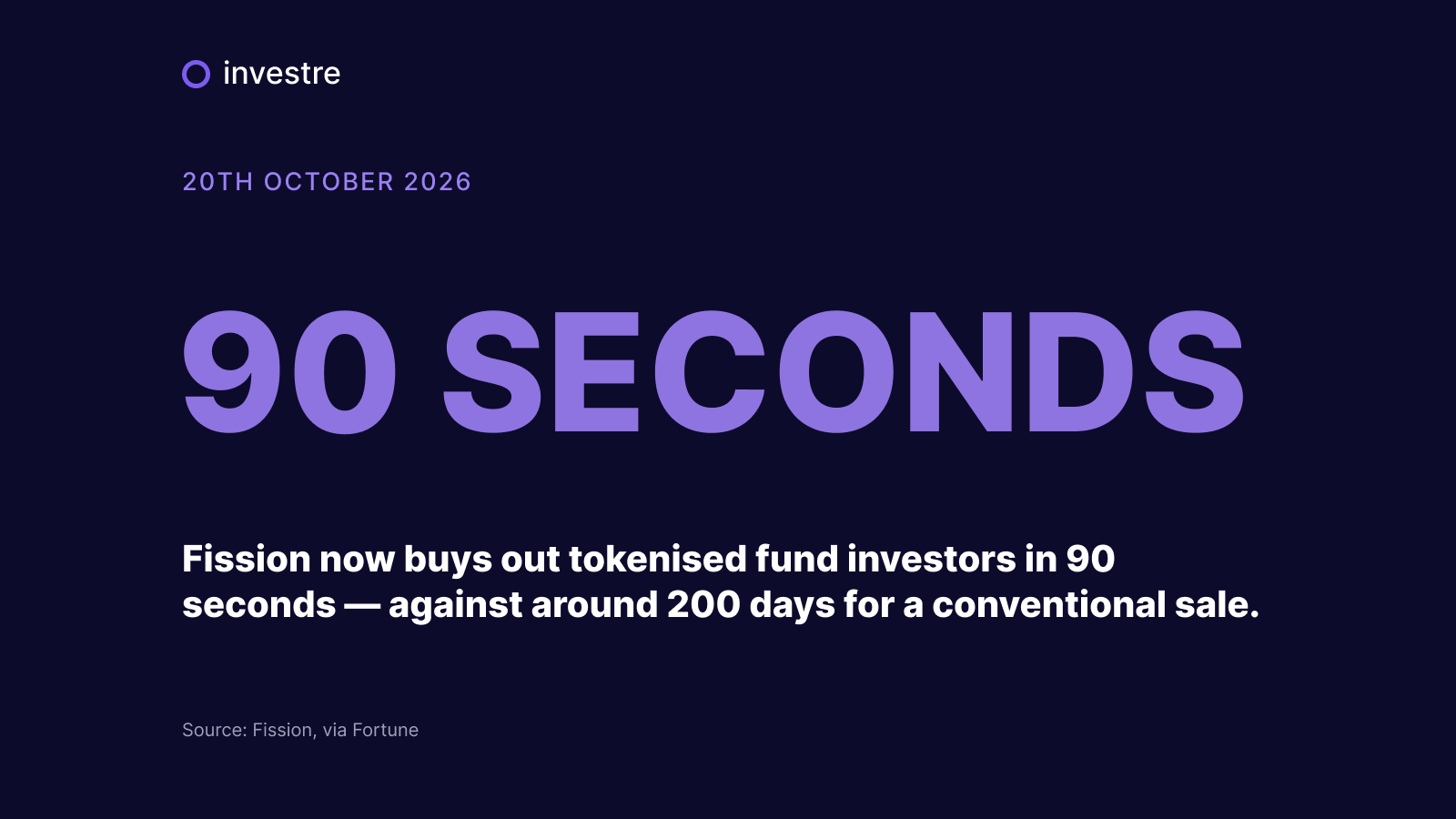
- Fission, a New York start-up, closed a $10 million Series A led by Pantera Capital, with Circle Ventures and Borderless Capital also investing; its CEO says sales of tokenised fund shares settle in 90 seconds or less, against around 200 days for a conventional sale.
- Broadcom, Verizon, UnitedHealth Group and six other US-listed companies objected to their shares being traded as tokens on OKXICE, according to a notice the venue published on 15 October 2026.
- Eight of the nine objectors were among the 63 securities OKXICE initially identified for trading.
Federated Hermes and Prometheum to bring tokenised funds into US brokerage accounts from 2027
Federated Hermes, a US asset manager with $911.6 billion under management as of 30 June 2026, has partnered with Prometheum to issue tokenised funds. Prometheum runs a group of SEC-registered broker-dealers specialising in digital securities: one will handle custody, clearing and settlement, while another will support distribution. Prometheum will also make the funds available to other broker-dealers through its clearing platform, so investors can buy them through conventional US brokerage accounts rather than standalone digital platforms. No fund has been named, and the firms expect to bring the first product to market in the first quarter of 2027. The announcement notes that money market funds have become a prominent use case across the tokenised asset market.
The Investre take: For tokenised funds, the bottleneck has moved from issuance to distribution: a fund only reachable on niche platforms will stay niche. European managers should be asking whether their tokenised share classes can reach the banks, platforms and distributors their investors already use.
Fission raises $10 million to buy tokenised fund shares from investors before redemption dates
Fission, a New York start-up, buys tokenised fund shares from investors who want their money back now, rather than waiting for the fund's next redemption date or for another buyer to appear. The seller connects a digital wallet, Fission handles the legal and trading steps, and in return for a fee the sale settles in 90 seconds or less; chief executive Jonathan Shaffer compares that with around 200 days for a conventional sale. Its clients are mostly institutions that hold assets on blockchains, such as hedge funds and stablecoin issuers keeping reserves in interest-earning tokenised products. The $10 million Series A, led by Pantera Capital with Circle Ventures and Borderless Capital also investing, closed in September and was announced on 15 October 2026.
The Investre take: Putting a fund on a blockchain doesn't make it liquid: someone still has to buy, and the transfer has to be legally recognised on the fund's register. In Luxembourg, providing that certainty for funds issued on-chain is the job of the Controlling Agent, and it matters most for semi-liquid structures like those Fission is targeting.
Broadcom, Verizon and UnitedHealth use SEC opt-out to keep their shares off the OKX–ICE token venue
Nine US-listed companies (Broadcom, Verizon, UnitedHealth Group, CoreWeave, AppLovin, Applied Digital, Rocket Lab, Cerebras Systems and Applied Optoelectronics) have objected to tokenised versions of their stock trading on OKXICE, the planned blockchain-based venue owned jointly by crypto exchange OKX and NYSE owner Intercontinental Exchange. Under the SEC's temporary innovation exemption, a venue offering tokens created by a third party must notify the listed company at least 30 days before trading, and an objection within that window blocks only that venue, not others. The objections were disclosed in a notice dated 15 October 2026 that gave no individual reasons, but Applied Optoelectronics told the Wall Street Journal it was unsure how tokenisation would affect its share price, liquidity and volatility, and worried investors might wrongly believe it had sponsored or endorsed the tokens. OKXICE will keep preparing to offer shares from companies that have not objected, and has not announced a launch date.
The Investre take: The objections show the gap between tokenising someone else's asset and issuing your own: a third-party token needs the issuer's consent, and can lose it. For European funds, the stronger model is the manager issuing the tokenised share itself, with the on-chain record as the legal one.
What this means for European fund managers
Luxembourg fund managers already have the legal basis to act on this. Under the Blockchain IV Law, an authorised Controlling Agent can maintain a fund's share register directly on a distributed ledger, without the need for a transfer agent or central securities depository. Investre was the first firm authorised to take on this role.
Further reading: Investre becomes the first Controlling Agent under Blockchain IV Law, or The Final Block podcast.
Authors