Tokenisation news, 11 November 2026
Together, the stories show tokenisation moving beyond money market funds into equity and active credit strategies, and two different routes for getting there.
Key takeaways
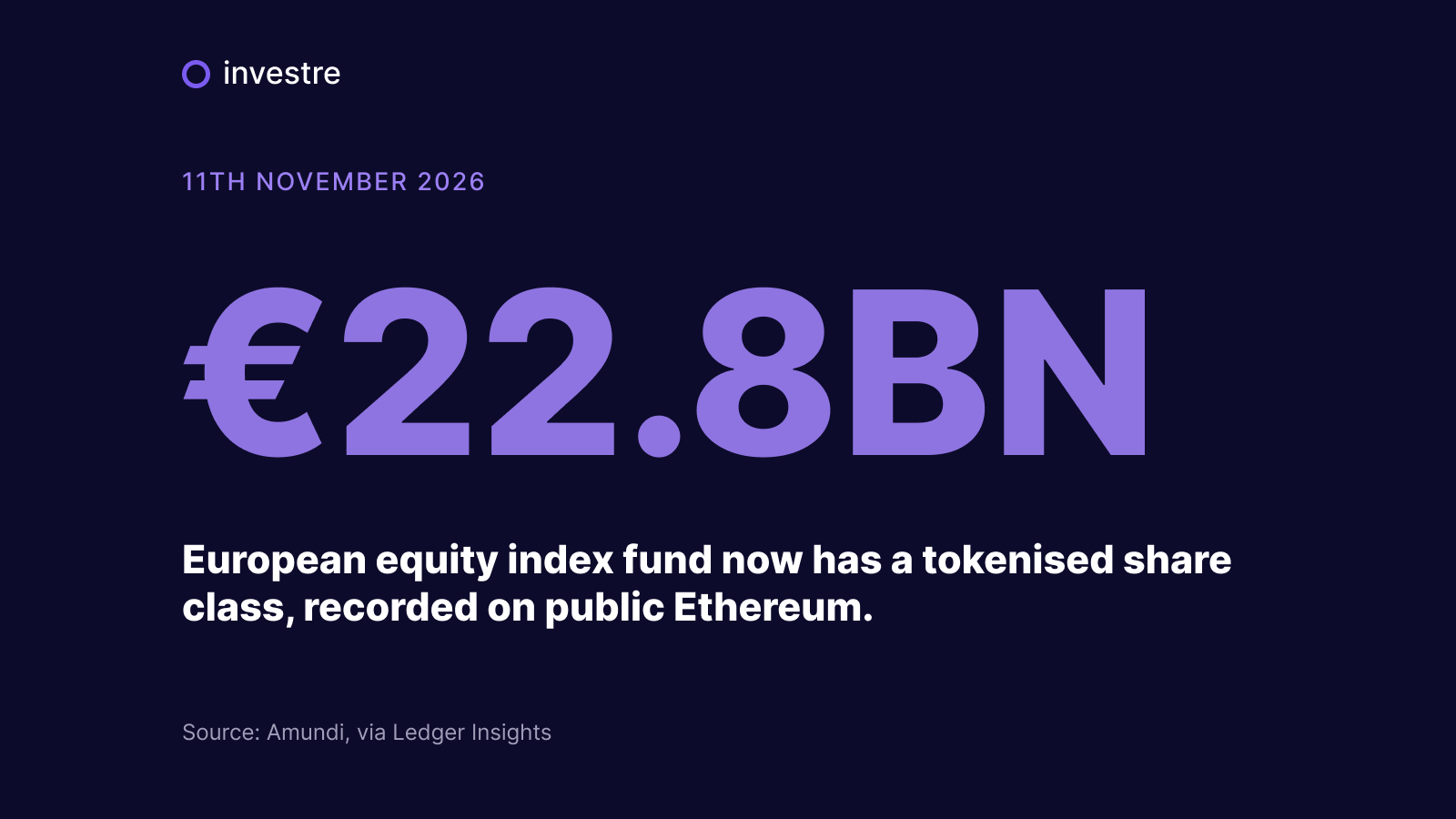
- Amundi added a tokenised share class, recorded on public Ethereum, to its €22.8 billion Core STOXX Europe 600 fund, with CACEIS as transfer agent and tokenisation agent.
- Schroders' $2.3 billion Emerging Market Bond fund, a Luxembourg UCITS, is available as a token on Solana through a British Virgin Islands feeder set up with Centrifuge, for professional investors outside the US with a $100,000 minimum.
- The ECB, the European Commission and ESMA invited industry to join the European Tokenisation Standards Group, which will write common technical standards for tokenised markets in the EU.
- Applications to join the European Tokenisation Standards Group close on 27 November 2026.
Amundi adds a tokenised share class to its €22.8bn European equity index fund
Amundi has added a tokenised share class to its Core STOXX Europe 600 fund, a €22.8 billion fund that underlies one of Europe's biggest equity ETFs, so investors can now hold units in it as digital tokens. The units are recorded on the public Ethereum blockchain, and CACEIS acts as both transfer agent and tokenisation agent. According to Ledger Insights, no European equity index fund of this size had offered an on-chain share class before. Amundi previously launched a tokenised share class of its Amundi Funds Cash EUR money market fund in November 2025.
The Investre take: If a €22.8bn equity tracker can carry a tokenised share class, so can most of a manager's UCITS range. Amundi's transfer agent could take it on; managers whose transfer agent can't will need a provider that can, whether as transfer agent or Control Agent.
Schroders' emerging market debt fund reaches on-chain investors through an offshore feeder
Schroders' $2.3 billion Emerging Market Bond fund, an actively managed Luxembourg UCITS, can now be bought as a token, but the fund itself has not been tokenised. Instead, a feeder vehicle in the British Virgin Islands, set up with the tokenisation platform Centrifuge, buys shares in the Schroders fund and issues tokens to investors on the Solana blockchain. Investors subscribe and redeem in USDC, a US dollar stablecoin, with a $100,000 minimum, and the product is open only to professional investors outside the US. Apollo and New York Life Investment Management have already used the same model.
The Investre take: This is the fast route on-chain: wrap a European fund offshore and leave the fund untouched. The trade-off is that investors hold a token in a BVI vehicle rather than a share in a UCITS, so managers should weigh that before letting a platform tokenise their strategy for them; tokenising a share class of the Luxembourg fund itself avoids that trade-off.
ECB, Commission and ESMA invite industry to lead a new European tokenisation standards group
On 9 November 2026, the European Central Bank, the European Commission and ESMA, the EU's markets regulator, invited wholesale market firms to join the European Tokenisation Standards Group. The new body will write shared technical standards so that tokenised markets across the EU connect instead of working in isolation. Industry members will chair the group and the three authorities will sit as observers; the group may also track compliance with the standards and advise the authorities on how to encourage it. The work supports the Commission's December 2025 market integration and supervision package, which would require post-trade firms to make DLT market infrastructures interoperable. Applications close on 27 November 2026.
The Investre take: The standards written here will decide whether a fund tokenised in Luxembourg can be settled and distributed across the EU without a custom connection to every venue. Managers, administrators and infrastructure providers already running DLT-native funds have the operating experience this group needs, and good reason to apply before 27 November.
What this means for European fund managers
Luxembourg fund managers already have the legal basis to act on this. Luxembourg law allows a fund's share register to be kept directly on a distributed ledger, and managers can choose between two models: a digital transfer agent that keeps the register on-chain, or a Control Agent under the Blockchain IV Law that oversees tokenised issuance and reconciles issued shares against investor holdings. Investre is licensed for both, so managers can choose the model that fits their fund's set-up. See how it works for digital issuance.
Further reading: Investre becomes the first Controlling Agent under Blockchain IV Law, or The Final Block podcast.
Authors