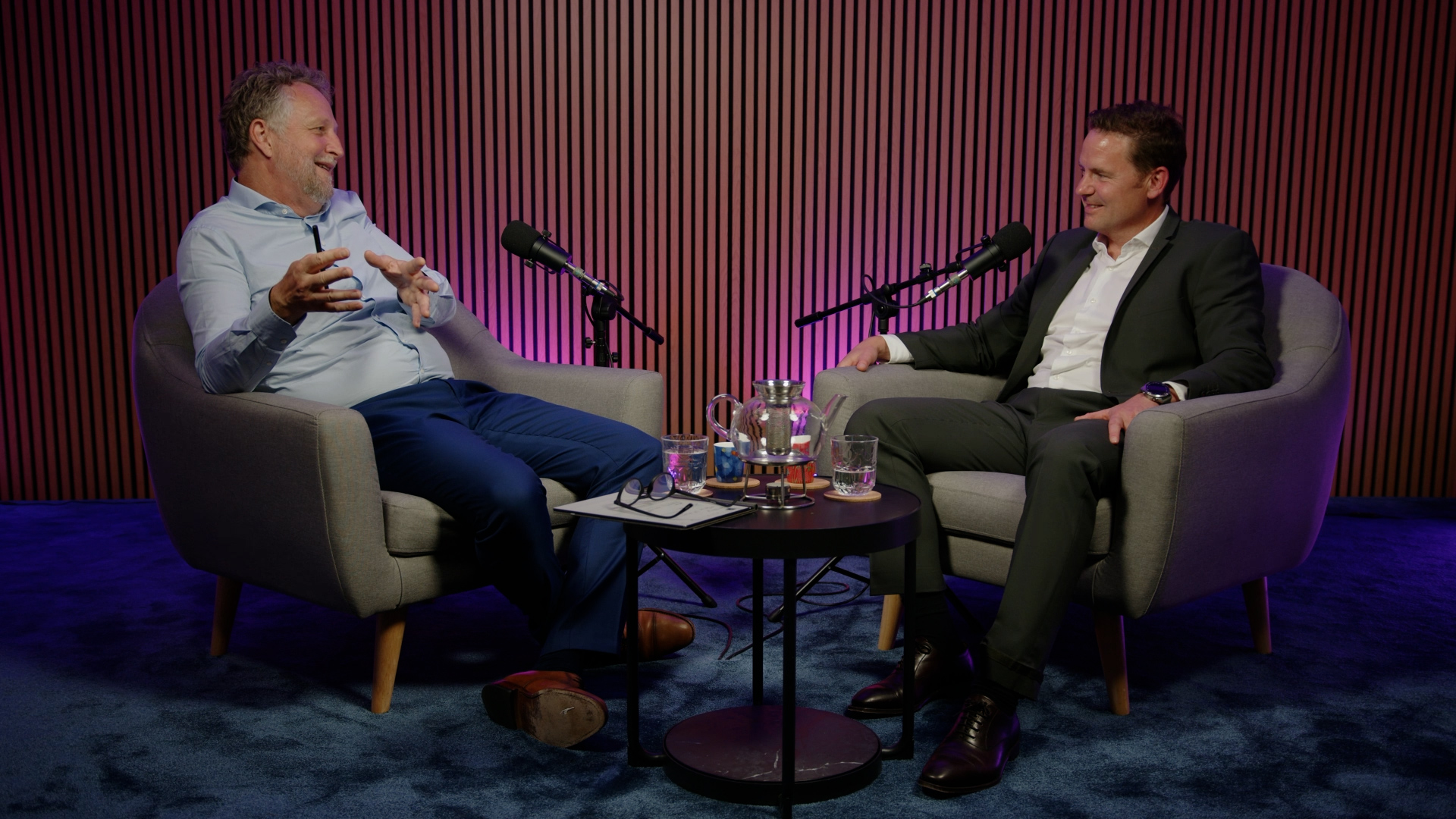
The Final Block Episode 11 | Why fund tokens need identity, not just a qallet: Daniel Coheur on standards, ERC-3643, and the future of treasury
Standards are boring until the moment they're missing. That's the throughline of this episode of The Final Block, where Georges Bock sits down with Daniel Coheur, co-founder of Tokeny and now Global Head of Digital Assets and Fund Distribution at Apex Group, to unpack why fund tokenisation needed its own standard, why a wallet address was never going to be enough, and where treasury management is actually headed.
.jpg)
Standards are boring until the moment they're missing. That's the throughline of this episode of The Final Block, where Georges Bock sits down with Daniel Coheur, co-founder of Tokeny and now Global Head of Digital Assets and Fund Distribution at Apex Group, to unpack why fund tokenisation needed its own standard, why a wallet address was never going to be enough, and where treasury management is actually headed.
Daniel's path here is unusual: he built his career in traditional clearing (Clearstream, then a mobile-telecom clearinghouse) before co-founding Tokeny in 2017. That background is exactly why he became the person who pushed the industry toward standardisation — he'd already watched it happen once, in mobile networks.
What is ERC-3643, and why does regulated tokenisation need it?
ERC-3643 is an Ethereum token standard purpose-built for regulated financial assets — designed so ownership, transfer restrictions, and compliance rules can be enforced directly by the token itself, not bolted on afterward.
The starting point was ERC-20, the standard behind the first wave of token launches nearly a decade ago. ERC-20 works fine for something like a utility token, where anyone can hold it. It breaks down the moment you need to ask questions like: is this holder an accredited investor? A Luxembourg resident? Eligible under this fund's restrictions? ERC-20 has no mechanism to enforce any of that. ERC-3643 was built specifically to close that gap — bringing compliance logic into the token's own smart contract library, so eligibility can be checked and enforced automatically, at the point of transfer.
Why identity matters more than the wallet
One of the sharper points in the conversation: in a permissionless world like Bitcoin, the private key is the proof of ownership — whoever holds it, owns the asset, no questions asked. That works for an unregulated asset. It doesn't work for a regulated one, where knowing who actually holds an asset isn't optional.
ERC-3643 addresses this by linking tokens to a verified on-chain identity, not just a wallet address — building on earlier identity standards (ERC-734/735) created by Fabian Vogelsteller, the same engineer who created ERC-20 itself. Practically, this means an independent party (a KYC agent or equivalent) attests to who's really behind the identity, and that attestation lives on-chain alongside the token. The wallet still signs the transaction, but ownership is tied to the verified identity behind it, not to whoever happens to hold the keys.
The role of "agents" — why regulated parties still need a seat at the table
A financial system built on the assumption that "we don't fully trust each other" doesn't disappear just because the infrastructure changed. ERC-3643 formalises this with the concept of an agent: a regulated third party — a custodian, a central securities depository, a paying agent — given a defined role to act on an asset without ever holding its private key.
This is the mechanism that lets tokenisation slot into an existing regulatory structure instead of requiring the law to be rewritten around the technology. Rather than reinventing financial market infrastructure from scratch, it gives it a way to operate on-chain: regulated entities keep doing the regulated things they were already responsible for, and the smart contract enforces who's allowed to do what.
From standard to network: what is T-REX?
Once a standard exists, adoption is the next problem — and adoption doesn't scale from a single company pushing it alone. That's why ERC-3643 was taken to the Ethereum community and became an official, open-source Ethereum standard (a three-year process), governed today by the non-profit ERC-3643 Association, with around 140 members spanning asset managers, legal firms, wallet providers, and infrastructure providers.
T-REX is the next layer up: an orchestration network addressing a real, practical problem — tokens increasingly need to move across multiple blockchain networks, not just live on one. Transport-layer solutions can move a token from one chain to another, but they don't necessarily carry its compliance logic with it. T-REX aims to be the layer that keeps compliance intact as a token crosses networks, so the receiving side can trust it's dealing with the genuine, properly-issued asset — not just a copy that lost its rules along the way.
Stablecoins, "always-on cash," and what it means for treasury
The most concrete near-term use case discussed: stablecoins reinventing corporate treasury management. Today, cash sitting in a corporate account is subject to old rhythms — a 4pm cut-off time, an overnight sweep into a money market instrument, a missed deadline meaning idle, non-yielding cash until the next cycle.
An always-on stablecoin balance removes that constraint. Cash can be swapped into a yield-bearing instrument, like a money market fund token, at any point — no cut-off, no waiting for the next business day. Daniel frames this as a shift toward measuring treasury efficiency in seconds rather than daily cycles — what he calls capital mobility. At small scale, that doesn't move the needle. At the scale of a large balance sheet, an idle weekend is real money.
The bigger pattern
A theme runs under all of this: infrastructure alone doesn't create adoption — utility does. Early tokenisation efforts often optimised for attracting activity to a network rather than solving an actual problem, using basic, compliance-blind standards that limited what the resulting tokens could actually do. What's changing now, per Daniel, is that the people building on top of tokenised infrastructure increasingly come from the industry itself — people who understand a specific pain point, not just people chasing a trend.
Authors